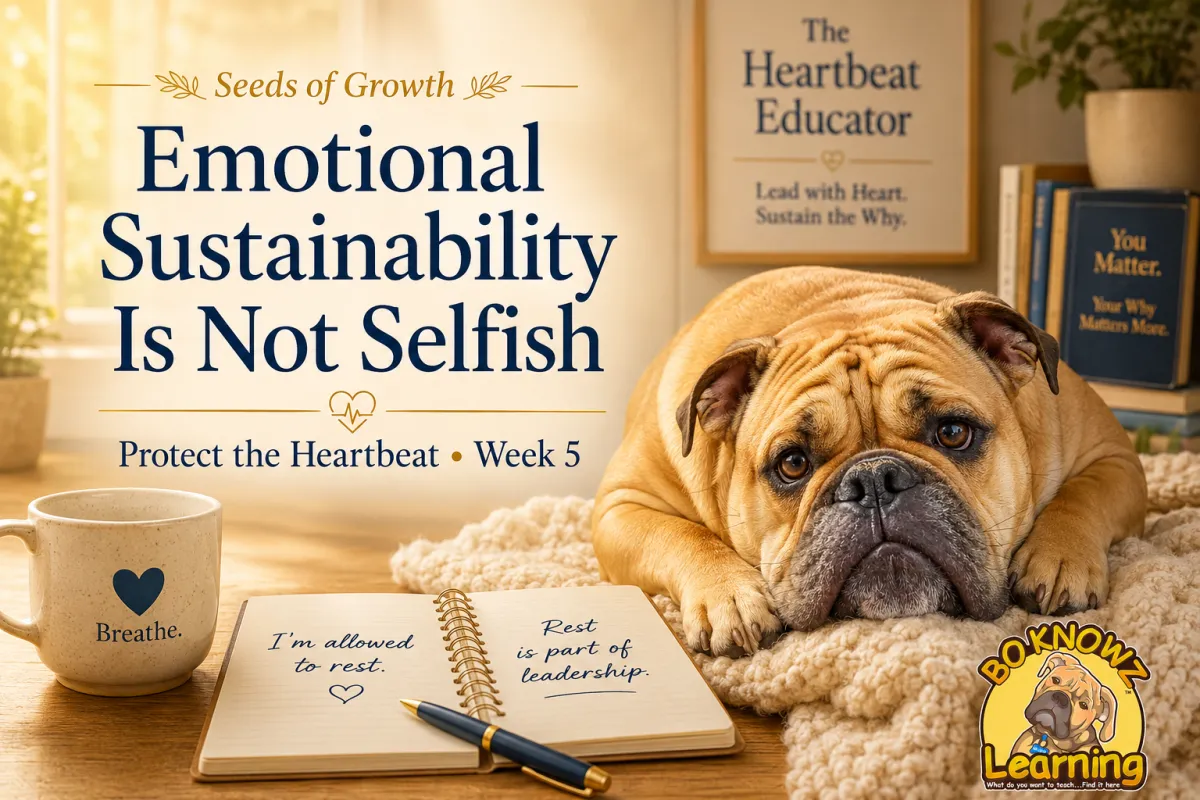
Emotional Sustainability Is Not Selfish
Protect the Heartbeat, Week 5
Educators are often praised for how much they give.
The extra time.
The emotional energy.
The patience.
The flexibility.
The way they keep showing up for students, families, colleagues, and school communities even when they are tired.
And there is beauty in that kind of commitment.
There is beauty in work rooted in care.
There is beauty in adults who notice, encourage, repair, support, and keep believing in young people.
But there is also a question we need to ask with honesty:
What happens when the work keeps asking educators to give more than they can sustainably carry?
Because caring deeply should not require educators to disappear inside the work.
Educators can be committed without being depleted.
They can be compassionate without abandoning themselves.
They can love students well without carrying everything alone.
Emotional sustainability is not selfish.
It is what helps educators stay present for the work that matters.
Caring Deeply Has a Cost
Teaching is not only an intellectual profession.
It is emotional work.
Relational work.
Human work.
Educators are constantly responding to people in real time.
They are noticing who needs encouragement.
They are adjusting tone.
They are repairing relationships.
They are holding boundaries.
They are managing transitions.
They are supporting students who arrive with needs that extend far beyond the lesson.
They are trying to stay steady when the day is anything but steady.
That kind of work requires emotional energy.
And when emotional energy is spent every day without recovery, the cost becomes real.
It may show up as irritability.
Numbness.
Decision fatigue.
A shorter fuse.
Difficulty feeling joy.
A sense of going through the motions.
The quiet thought, “I do not know how much longer I can keep doing this.”
These are not signs that educators do not care.
Often, they are signs that educators have cared deeply for a long time without enough support, restoration, or protection.
Sustainability Is Not the Same as Selfishness
Many educators struggle with the idea of protecting their own emotional capacity.
They worry it sounds selfish.
They worry it means they are doing less for students.
They worry boundaries will be misunderstood as a lack of commitment.
But sustainability is not selfishness.
Sustainability is stewardship.
It is paying attention to the human being doing the work.
It is recognizing that educators are not unlimited resources.
It is understanding that presence, patience, creativity, and compassion all require renewal.
A teacher who is emotionally depleted may still care deeply.
But care alone does not restore capacity.
A leader who is running on empty may still believe in the mission.
But belief alone does not regulate the nervous system.
A school community may be full of dedicated adults.
But dedication alone cannot compensate for systems that continually overextend people.
Emotional sustainability asks a different question.
Not “How much more can I give?”
But “What helps me keep showing up with integrity, clarity, and heart?”
Boundaries Protect the Work
Boundaries are often misunderstood.
They can sound harsh.
Rigid.
Unkind.
But healthy boundaries are not walls.
They are structures that protect what matters.
A boundary might sound like:
“I need time to think before responding.”
“I cannot answer emails at all hours and remain fully present during the day.”
“I need support after that difficult conversation.”
“I can care about this deeply without carrying it alone.”
“I need recovery in order to return with steadiness.”
These are not selfish statements.
They are sustainability statements.
Boundaries help educators remain connected to the work without being consumed by it.
They help adults protect their ability to respond instead of react.
They help preserve emotional presence.
They help keep compassion from becoming depletion.
And in school culture, boundaries matter because adults who are constantly overextended cannot remain steady forever.
Emotional Sustainability Is a Culture Issue
Just like educator well-being, emotional sustainability cannot be left entirely to individual educators.
It is not enough to tell teachers to “take care of themselves” while the culture continues to reward overextension.
It is not enough to encourage rest while systems make rest feel impossible.
It is not enough to talk about wellness while adults are expected to absorb constant pressure without meaningful support.
Emotional sustainability is shaped by culture.
It is shaped by:
Clear communication.
Realistic expectations.
Trust.
Recovery after difficult moments.
Time to think.
Supportive leadership.
Permission to be human.
Respect for boundaries.
Systems that reduce unnecessary overwhelm instead of depending on adults to quietly absorb it.
A school culture that values emotional sustainability does not lower expectations.
It strengthens the adults who are working to meet them.
That is not soft.
That is strategic.
That is leadership.
That is heartbeat work.
Students Benefit From Sustainable Adults
Students do not need exhausted adults pretending to be fine.
They need adults who can return.
Adults who can repair.
Adults who can model what it looks like to pause, breathe, set a boundary, ask for help, and try again.
Students benefit when educators have enough emotional capacity to be present.
They benefit when adults can hold expectations with warmth.
They benefit when classrooms are led by people who are supported enough to stay connected.
They benefit when school cultures protect the adults who protect them.
This is why emotional sustainability is connected to student success.
Not because students are responsible for adult well-being.
They are not.
But because the adult's emotional state becomes part of the learning environment.
The steadiness of educators matters.
And steadiness requires care.
What Bo Reminds Me 🐾
Bo has no trouble honoring his limits.
When he is tired, he rests.
When he needs connection, he leans in.
When the day has been full, he finds a quiet place and settles.
He does not apologize for needing what he needs.
He does not explain why rest matters.
He simply listens to his body.
There is wisdom in that.
Bo reminds me that living things need recovery.
Not because they are weak.
Because they are alive.
Educators are alive too.
They are human beings with hearts, bodies, minds, stories, and limits.
And those limits deserve attention before exhaustion becomes crisis.
A Reflection for This Week
This week, I invite you to pause and reflect:
Where am I giving from commitment, and where am I giving from depletion?
What helps me return to myself after a hard day?
What boundary would protect my ability to stay present?
Where do I need support instead of more pressure?
What would emotional sustainability look like in my classroom, school, or leadership role?
These questions are not about doing less because the work does not matter.
They are about staying connected to the work because it does matter.
As You Move Forward
Emotional sustainability is not selfish.
It is not a lack of dedication.
It is not weakness.
It is not stepping away from what matters.
It is how educators keep showing up without losing themselves inside the work.
If educators are the heartbeat of education, then protecting the heartbeat means protecting the emotional capacity of the people doing the work.
Students need adults who are safe, seen, steady, and supported.
And educators deserve to be safe, seen, steady, and supported too.
The work matters.
The children matter.
The mission matters.
And so do the adults carrying it.
That is why emotional sustainability is not selfish.
It is part of how we protect the heartbeat.
Join the Conversation
If this message resonates with you, I invite you to join us inside The Steady Schools Community — a free space for educators, leaders, and caregivers who are committed to building cultures where adults and students can feel safe, seen, steady, and supported.
Inside the Community, we reflect, share practical tools, encourage one another, and continue conversations like this one with heart, honesty, and purpose.
Join us here:
https://www.skool.com/bo-knowz-learning-7950/about
Because protecting the heartbeat of education is not work we were meant to do alone.
🌱 Protect the heartbeat.