From Compliance to Compassion: Building Belonging Into Your School's DNA
This is not a program to implement. It is a culture to grow.
If you're just joining us, this is Part 4 of a 4-part series based on my recent article in AASA's School Administrator magazine. Start with Part 1 here → AASA March 2026 Belonging Article
Four weeks ago, I asked you to consider something uncomfortable.
What if we've been defining "the basics" too narrowly?
What if reading, writing, and arithmetic — as essential as they are — cannot take root without something far more foundational underneath them?
What if belonging is a basic?
Over the past three weeks, we've explored what that means at the levels of biology, neuroscience, and adult culture. We've looked at what the brain needs to learn, why students disengage, and why your staff has to feel it before your students ever will.
Today, we bring it all home.
Because belonging doesn't become a school's reality through a single initiative, a professional development day, or a new program in a three-ring binder. It becomes real when it is woven into the operational DNA of how a school runs — how leaders lead, how adults relate, how systems communicate care.
That is the shift from compliance to compassion. And it is the most important work a school leader can do.
What compliance-centered schools look like
Compliance-centered schools are not bad schools. They are often well-intentioned schools doing exactly what the system asked of them.
They have handbooks. They have procedures. They have consequences clearly posted on classroom walls. Adults manage behavior. Leaders monitor metrics. Meetings are efficient and focused on data.
But in compliance-centered schools, belonging is assumed rather than built. The unspoken message is: follow the rules and you will be fine here.
For students who arrive already regulated, already connected, already trusting — that is enough.
For the students who need the school most, it rarely is.
What compassion-centered schools look like
Compassion-centered schools are not soft schools. They are not schools without structure or accountability.
They are schools where belonging is a measurable outcome, not an assumed one.
Advisory programs ensure every student has a consistent adult advocate. Restorative practices replace exclusion with dialogue, reflection, and repair. Inclusive instructional design addresses diverse learning profiles, cultural backgrounds, and emotional needs — not as accommodations, but as standard practice.
Student support teams analyze data not to sort students, but to prevent students from falling through the cracks. Professional learning is embedded, relational, and ongoing. And leadership — at every level — models the very vulnerability, curiosity, and care they are asking of everyone else.
In these schools, conversations about "problem students" have evolved into conversations about students with unmet needs. The collective mindset has shifted from reactive to reflective, from compliance to compassion.
And the data follows.
Office referrals decrease. Chronic absenteeism declines. Student surveys show marked increases in felt safety and belonging. Teachers report stronger relationships and greater collaboration. The culture becomes self-reinforcing — because when people feel they belong, they invest in belonging for others.
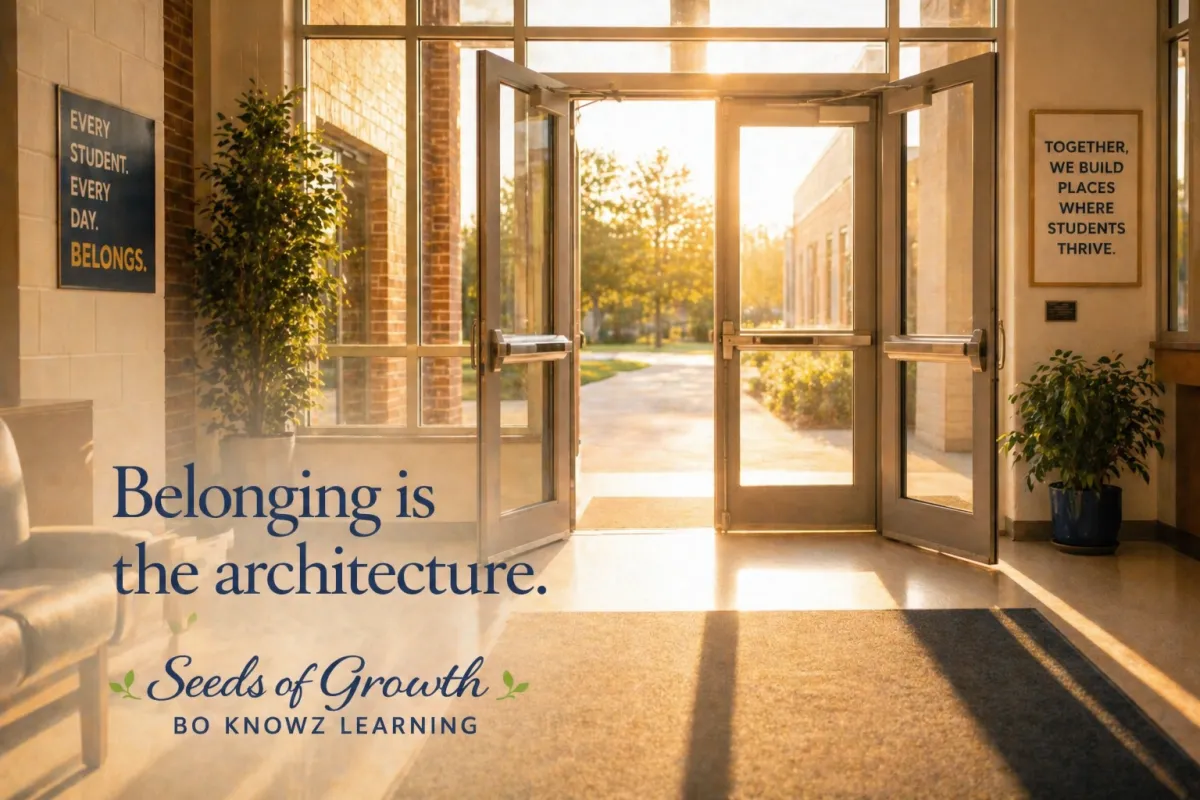
This is not an add-on. This is the architecture.
Here is what I need every school leader reading this to hear:
Advisory programs, restorative practices, and inclusive instruction cannot exist as add-ons. They cannot be the thing you do after the "real" work is finished. They must be integrated into the school's operational DNA — into scheduling, into hiring, into how you run a staff meeting, into how you greet a student in the hallway at 7am.
Belonging has to be structural. It has to be intentional. And it has to start at the top.
For superintendents and district leaders, the charge is clear: invest in professional learning that empowers leaders to lead with empathy and skill. Create structures that make student belonging a measurable outcome, not an assumed one.
This is the work The Steady Schools Framework was built for — not a program to implement, but a culture to grow. When the systems, relationships, and leadership in a school are steady — not perfect, but steady — belonging follows. And when belonging follows, learning does too.
A closing thought — and an invitation
When we design schools where every student feels seen, valued, and supported, we do not just strengthen learning.
We restore the heart of education itself.
That is why I wrote the AASA article. That is why I wrote this series. That is why I built Bo Knowz Learning and The Steady Schools Framework. Because after 34 years in schools, I am more convinced than ever that this work is not optional.
It is the work.
And you do not have to do it alone.
Pause & Reflect: Where is your school still operating from a compliance mindset? Where has compassion already taken root? And what is the one structural shift — not a program, but a design decision — that could move the needle most right now?
If this series resonated with you, I'd love to connect. Visit boknowzlearning.com to learn more about The Steady Schools Framework — or join us in the Steady Schools Community, where leaders like you are doing exactly this work, together. Here is the link to the complimentary invitation: The Steady Schools Community
— Dr. Kimberly Honnick, Ed.D. | Founder, Bo Knowz Learning