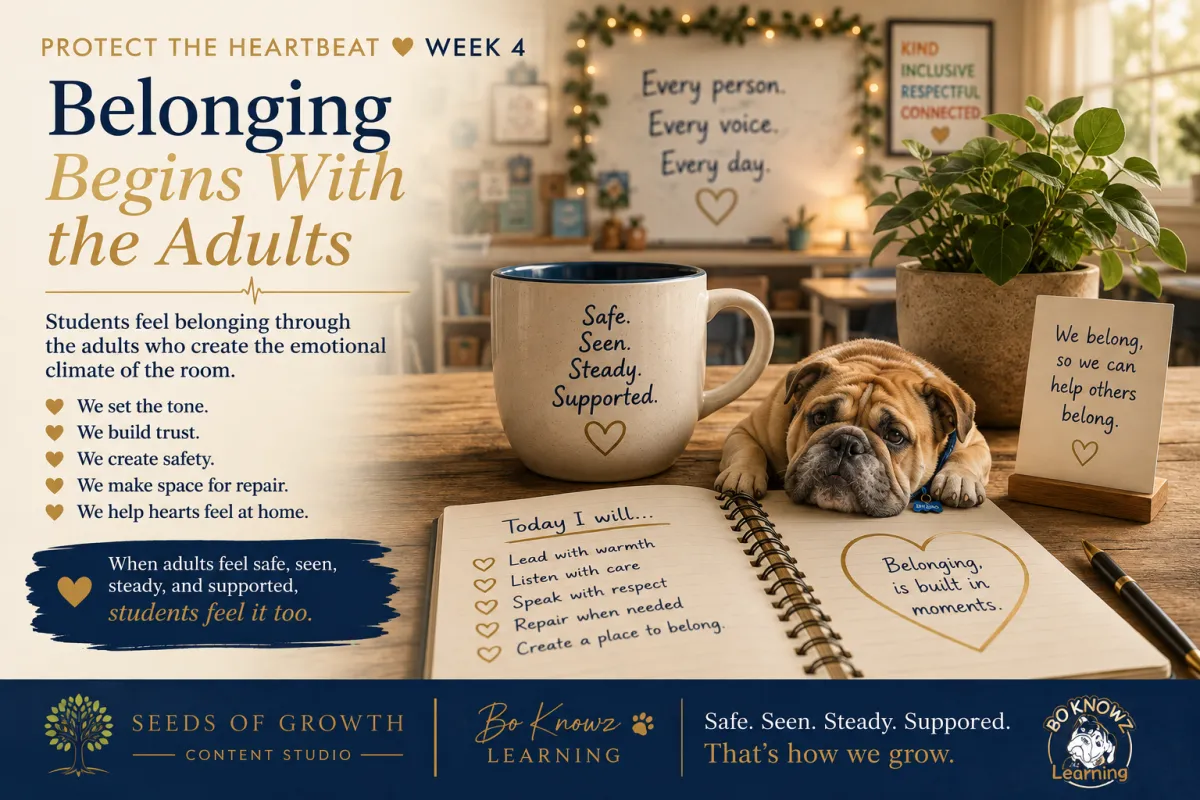
Belonging Begins With the Adults
Protect the Heartbeat, Week 4
Belonging is one of the most powerful needs in a classroom.
Students need to know they matter.
They need to know there is a place for them.
They need to know mistakes will not remove them from connection.
They need to know their voice, identity, effort, and presence are welcomed.
They need to feel safe enough to learn.
And in many schools, we are talking more intentionally about student belonging than ever before.
That matters.
But there is another question we cannot ignore:
Do the adults feel like they belong too?
Because students do not experience belonging through posters, slogans, or programs alone.
They experience belonging through the adults who create the emotional climate of the room.
And adults are more able to create belonging when they are working in cultures where they also feel safe, seen, steady, and supported.
Belonging Is Felt Before It Is Explained
Students know when belonging is real.
They feel it in the way adults greet them.
They feel it in the way mistakes are handled.
They feel it in the tone used during correction.
They feel it in whether the classroom has room for repair.
They feel it in whether the adult sees the whole child or only the behavior in front of them.
Belonging is not simply something we teach students to value.
It is something students experience repeatedly through the culture around them.
A student may not have the words to say, “This environment feels emotionally safe.”
But they know when their shoulders drop.
They know when they can ask a question.
They know when they can try again.
They know when they can be themselves without constantly bracing for rejection, shame, or disconnection.
That kind of belonging is built through steady adult presence.
And steady adult presence requires support.
Adults Cannot Give What the Culture Does Not Support
Educators are often expected to create classrooms where students feel connected, respected, regulated, and included.
But too often, the adults themselves are working in environments where they feel isolated, unseen, overwhelmed, or unsupported.
That matters.
Because adults are not machines that produce belonging on demand.
They are human beings who are also shaped by the culture around them.
When educators feel safe enough to be honest, they are more able to create honesty with students.
When educators feel seen, they are more able to notice students deeply.
When educators experience relational trust, they are more able to build trust with students.
When educators are supported through difficult moments, they are more able to support students through theirs.
This does not mean adults need perfect conditions in order to love students well.
Educators do extraordinary work in imperfect conditions every day.
But we should not build systems that depend on educators constantly giving what they are not receiving.
Belonging cannot be only for students.
Belonging has to be part of the adult culture too.
The Staff Culture Becomes the Student Culture
Students feel the adult culture of a building.
They may not know the details of staff meetings, leadership decisions, communication patterns, or team dynamics.
But they feel the results.
They feel whether adults are tense or connected.
They feel whether the school is operating from trust or fear.
They feel whether teachers have enough support to stay present.
They feel whether adults collaborate or protect themselves.
They feel whether the building has a steady pulse or a reactive one.
The adult culture does not stay in the staff room.
It travels into classrooms, hallways, meetings, emails, arrival, dismissal, and every interaction in between.
This is why belonging begins with the adults.
Not because adults matter more than students.
But because adults shape the conditions students experience.
A school cannot create a deep culture of student belonging while ignoring the belonging needs of the people asked to build it.
Belonging Is Not the Same as Comfort
Belonging does not mean everyone agrees.
It does not mean every conversation is easy.
It does not mean accountability disappears.
It does not mean avoiding hard truths.
In fact, real belonging makes hard conversations more possible.
When adults feel like they belong, they are more able to receive feedback without feeling erased.
They are more able to ask for help without feeling weak.
They are more able to name concerns without fear of punishment.
They are more able to repair after conflict.
They are more able to stay connected while working through difficult things.
The same is true for students.
Belonging is not the absence of challenge.
It is the presence of connection, dignity, safety, and support during challenge.
That is culture work.
That is leadership work.
That is heartbeat work.
What This Means for Leaders
Leaders shape belonging by shaping the emotional conditions of the adult community.
They shape whether people feel safe enough to speak honestly.
They shape whether staff members feel known beyond their productivity.
They shape whether communication builds clarity or anxiety.
They shape whether mistakes are treated as evidence of failure or opportunities for learning.
They shape whether the school culture honors the humanity of adults as well as students.
This does not require grand gestures.
Often, adult belonging is built in small, consistent ways.
A leader follows up after a hard day.
A team creates space for honest reflection.
A meeting begins with clarity instead of chaos.
A teacher’s concern is taken seriously.
A staff member hears, “I see how much you carried this week.”
A mistake is met with repair instead of shame.
A boundary is respected.
Support arrives before depletion becomes crisis.
These moments matter.
They teach adults what kind of culture they are part of.
And adults carry that culture into their work with students.
What Bo Reminds Me 🐾
Bo has a way of making belonging visible.
He does not need a long explanation to know when he is welcomed.
He feels it.
He notices tone.
He notices presence.
He notices whether the room is calm enough to settle.
And when he feels safe, he leans in.
There is something beautifully simple about that.
Belonging is not always complicated.
Sometimes it begins with the feeling of being welcomed, noticed, and accepted without needing to perform.
Educators need that too.
A place to exhale.
A place to be honest.
A place to feel connected.
A place to remember that they are more than what they produce, manage, fix, or carry.
When adults experience belonging, they are better able to create it.
A Reflection for This Week
This week, I invite you to pause and reflect:
Where do adults in your school or organization feel most connected?
Where might they feel unseen or unsupported?
What does belonging look like for the adults who are expected to build it for students?
How are mistakes, feedback, conflict, and hard days handled?
What is one small way to help an educator feel safe, seen, steady, or supported this week?
These questions matter because belonging is not built by intention alone.
It is built through repeated experiences.
Students need those experiences.
Adults do too.
As You Move Forward
Belonging begins with the adults.
Not because student belonging is less important.
But because student belonging is shaped by the adults who hold the learning environment every day.
If we want students to feel safe, seen, steady, and supported, we must create cultures where educators can experience those things too.
Educator belonging is not a bonus.
It is not a soft extra.
It is part of the emotional architecture of a school.
And when adults feel connected, trusted, respected, and supported, they are more able to build classrooms where students feel that same sense of safety and belonging.
If educators are the heartbeat of education, then protecting the heartbeat means protecting the conditions that allow adults to belong.
That is how school culture grows.
That is how classrooms become steadier.
That is how students experience the kind of belonging that helps them learn, risk, repair, and become.
Join the Conversation
If this message resonates with you, I invite you to join us inside The Steady Schools Community — a free space for educators, leaders, and caregivers who are committed to building cultures where adults and students can feel safe, seen, steady, and supported.
Inside the Community, we reflect, share practical tools, encourage one another, and continue conversations like this one with heart, honesty, and purpose.
Join us here:
https://www.skool.com/bo-knowz-learning-7950/about
Because protecting the heartbeat of education is not work we were meant to do alone.
🌱 Protect the heartbeat.