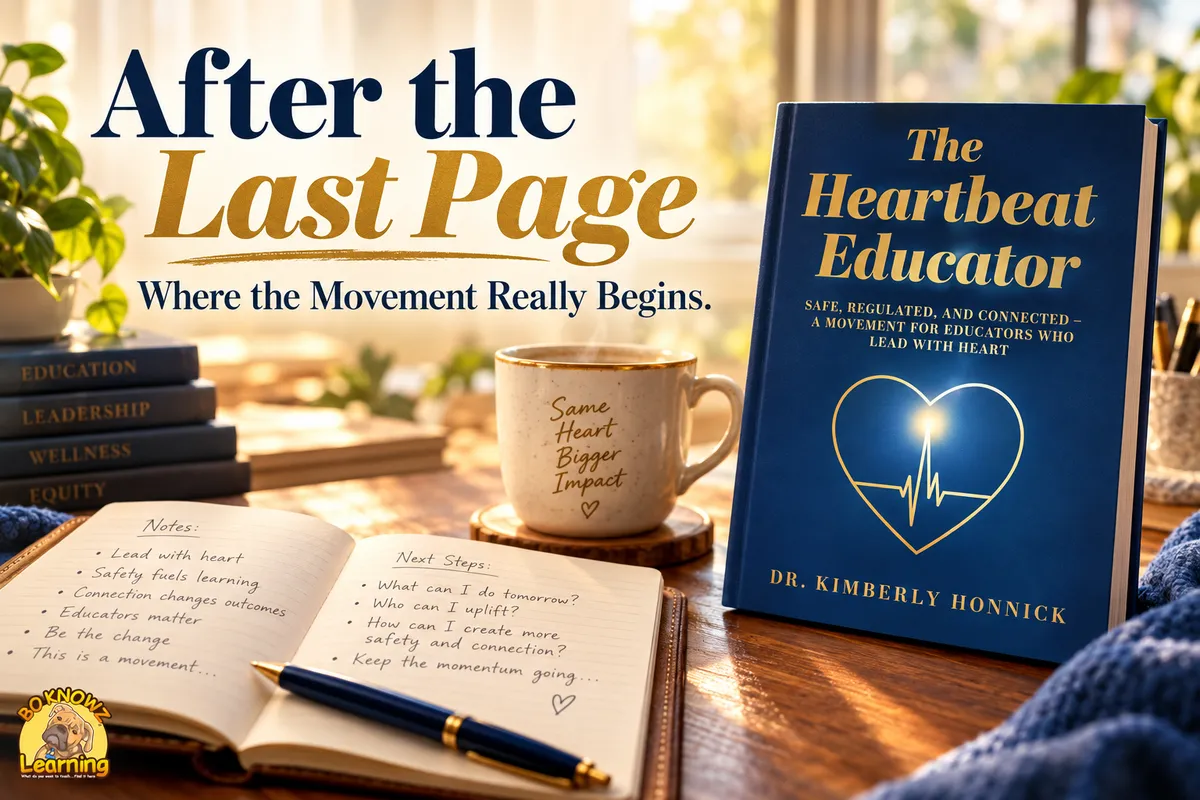
After the Last Page: Where the Movement Really Begins
How reflection, practice, and shared stories carry The Heartbeat Educator beyond the book
There is a moment every author eventually has to accept.
You finish writing the book.
You revise it.
You hold it.
You launch it.
And then you let it go.
The words that lived privately with you for so long begin belonging to other people.
Readers bring their own stories to them.
Their own classrooms.
Their own memories.
Their own hard moments.
Their own hopes.
Their own interpretations.
And something begins to happen that the author can no longer control.
The book starts living beyond the page.
Since The Heartbeat Educator launched, I have been thinking about that a lot.
Because I never wanted the final page to be the end of this work.
In many ways, I hoped it would be the beginning.
A Book Can Offer Language. Practice Gives It Life.
Reading about belonging matters.
Creating belonging in an ordinary Tuesday afternoon matters more.
Reading about regulation matters.
Remembering to pause when a student pushes every button you have matters more.
Reading about repair matters.
Going back after a difficult interaction and saying, “I wish I had handled that differently. Can we try again?” matters more.
Reading about dignity matters.
Choosing a quiet correction instead of public embarrassment matters more.
Reading about educator well-being matters.
Recognizing that you cannot continually pour from depletion and asking for support matters more.
That is when a book becomes something other than words.
It becomes practice.
It becomes a choice.
It becomes a moment.
And sometimes, the smallest moment becomes the one another person remembers.
The Movement Lives in the Ordinary
When we hear the word “movement,” it can sound enormous.
We picture crowds.
Campaigns.
Stages.
Big declarations.
But most change does not begin that way.
It begins quietly.
A teacher decides to lower their voice.
A school leader notices that a staff member is carrying too much.
An educator changes one phrase.
A family and teacher begin a difficult conversation with curiosity instead of defensiveness.
Someone apologizes.
Someone listens longer.
Someone notices the child who has stopped participating.
Someone says:
“You belong here.”
Someone else says:
“I need help.”
Those moments rarely receive applause.
But they change the emotional pulse around us.
That is where I believe this movement lives.
Not only in the book.
Not only online.
Not only in a hashtag.
In the way we choose to show up when another human being is standing in front of us.
You May Notice Something Different Now
One of my hopes for The Heartbeat Educator was never that readers would finish it thinking:
“I have 27 new things I need to do.”
Educators already have enough things to do.
Instead, I hoped readers might begin noticing differently.
Maybe you notice your tone.
Maybe you notice the child whose behavior is telling a story.
Maybe you notice when your own nervous system is asking for a pause.
Maybe you notice where belonging is strong—and where it is missing.
Maybe you notice how often educators are expected to regulate everyone else while receiving very little support themselves.
Maybe you notice a moment of repair that would once have passed unnoticed.
Maybe you recognize something you have been doing for years and finally have language for it.
That matters too.
Sometimes growth is not about adding something new.
Sometimes it is about becoming more intentional about something that was already there.
The Book Is a Mirror as Much as It Is a Guide
I have always hoped this book would function as more than a set of ideas.
I hoped it would become a mirror.
A place where educators could recognize themselves.
Their strengths.
Their humanity.
Their emotional labor.
Their mistakes.
Their ability to repair.
Their need for boundaries.
Their influence.
Their capacity to create safety, belonging, connection, and possibility.
And perhaps most importantly:
Their worth beyond what they produce.
Because educators hear many messages about what they should improve.
What they should implement.
What they should measure.
What they should accomplish.
There are fewer moments when someone says:
Look at what you are already carrying.
Look at what your presence makes possible.
Look at the human work inside the professional work.
That is part of what I wanted these pages to hold.
What Did You Carry With You?
Now that people are reading the book, one question matters more to me than whether someone simply says they “liked” it.
I want to know:
What stayed with you?
Was there a sentence you underlined?
A chapter that made you pause?
A story that reminded you of a student?
A moment that made you think differently about your own practice?
Something that affirmed what you already knew?
Something that challenged you?
Something you want to bring into your classroom, leadership, family partnership, or team?
Those reflections are where the book begins taking on a life beyond mine.
Because readers notice things authors cannot predict.
They bring meaning to the work through their own experiences.
And then they carry those ideas somewhere new.
Reviews Are Part of That Story
This is also why honest reviews matter so much to me right now.
Yes, reviews help other readers discover a new book.
But they do something else.
They tell the story of what happened when the book met a reader.
A review might say:
“This reminded me why I teach.”
Or:
“This gave me language for something I have felt for years.”
Or:
“This challenged the way I think about regulation.”
Or:
“I wish every school leader would read this.”
Or perhaps:
“This chapter stayed with me because…”
That reflection becomes another doorway.
Someone else reads it and thinks:
Maybe this book is for me.
That is why, if you have read The Heartbeat Educator and it has given you something worth carrying, I would be deeply grateful if you shared an honest review.
Not because every reader needs to say the same thing.
Quite the opposite.
I want your experience.
Your reflection.
Your story.
Because reviews are not simply ratings.
They are readers helping other readers find their way into the conversation.
And if this message resonates with you and you would like to help carry it forward in a more intentional way, I would also love to welcome you into The Heartbeat Educator Founding Circle, a group of early supporters helping share the book and amplify the movement:
https://theheartbeateducator.com/founding-circle
From Reflection to Practice
Of course, the movement cannot stop with reflection.
The question eventually becomes:
What will I do with what I noticed?
Maybe nothing dramatic.
Maybe tomorrow you greet students differently.
Maybe you replace:
“What is wrong with you?”
with:
“What happened?”
Maybe you repair something.
Maybe you pause before correcting publicly.
Maybe you check on a colleague.
Maybe you protect one boundary.
Maybe you tell an educator:
“I see what you are carrying.”
Maybe you walk into a leadership meeting asking not only what students need, but what the adults supporting those students need too.
Those are small choices.
But culture is built from small choices repeated over time.
One Heartbeat Moment at a Time
There is a phrase I keep returning to:
Heartbeat Moment.
A Heartbeat Moment is not necessarily dramatic.
It is simply a moment when presence, dignity, belonging, regulation, connection, or repair changes what happens next.
Sometimes the child remembers it.
Sometimes the educator remembers it.
Sometimes nobody realizes its importance at all.
But something shifted.
Someone felt safer.
Someone felt seen.
Someone stayed connected.
Someone tried again.
Someone remembered they belonged.
Those moments are the real movement.
And they happen every day.
A Reflection for This Week
If you have read The Heartbeat Educator, I invite you to reflect:
What stayed with you after the last page?
What did the book help you notice?
What did it affirm?
What challenged you?
What is one idea you want to carry into practice?
And what is one story or reflection you might share so another educator can find their way into this conversation?
If you have not read it yet, perhaps the reflection is even simpler:
What kind of educator do I want people to experience when they are with me?
That question alone can change a moment.
Where the Movement Really Begins
Launching The Heartbeat Educator was an extraordinary milestone for me.
But launch day was never the destination.
The destination cannot be a sales number.
Or an Amazon page.
Or a stack of books.
The destination is what happens because the message traveled.
An educator feels seen.
A leader changes a conversation.
A student experiences dignity.
A family experiences partnership.
An adult chooses repair.
A teacher protects their own emotional sustainability.
A school starts asking different questions.
That is where the movement becomes real.
The book carries the language.
Readers carry the stories.
Educators carry the practice.
And every Heartbeat Moment carries the movement one step farther.
The final page is not the end.
It is where the invitation begins.
🌱 Protect the heartbeat.
Carry It Forward
If The Heartbeat Educator has spoken to you, there are several meaningful ways you can help carry the heartbeat forward:
Read it. Reflect on the educator you are—and the educator you are becoming.
Practice it. Choose one small Heartbeat Moment where presence, dignity, belonging, or repair can change what happens next.
Share it. Think of one educator who may need this message.
Tell your story. Honor a Heartbeat Educator whose presence mattered to you.
Leave an honest review. Your experience may be the reason another educator discovers the book.
Join the Founding Circle. Help carry the message into more classrooms, schools, organizations, and conversations:
https://theheartbeateducator.com/founding-circle
And if you are looking for a place to keep reflecting and connecting, I would love to welcome you into The Steady Schools Community:
https://www.skool.com/bo-knowz-learning-7950/about
The book has been written.
The pages are in the world.
Now the movement lives in what we do with them. 💙