Why Your Adults Have to Feel It First
Seeds of Growth · Bo Knowz Learning · Series: Belonging Is a Basic, Part 3 of 4
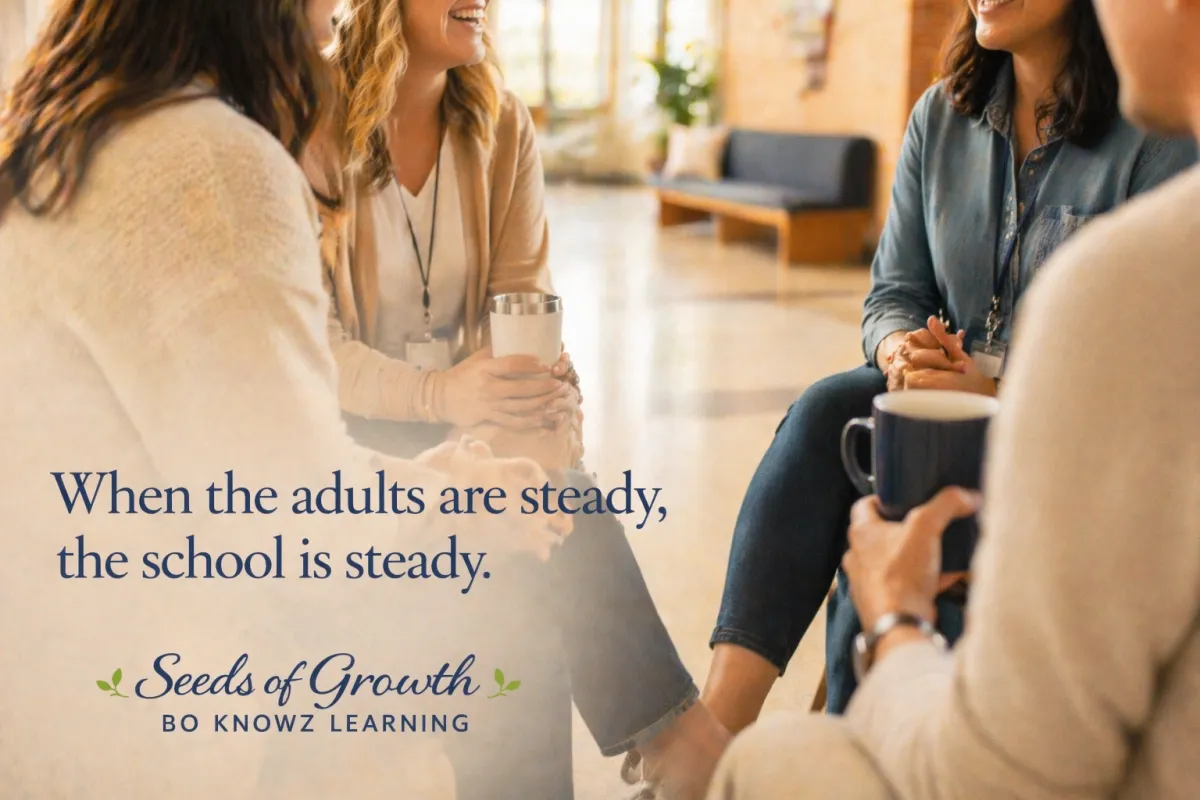
You cannot build a steady school on an unsteady staff.
If you're just joining us, this is Part 3 of a 4-part series based on my recent article in AASA's School Administrator magazine.
Start with Part 1 here → https://www.boknowzlearning.com/post/belonging-week-1, followed by Part 2 here → https://www.boknowzlearning.com/post/brain-safe
I want to tell you about a school I walked into early in my consulting work.
The principal was talented, committed, and genuinely cared about every student in that building. The programs were in place. The initiatives were running. On paper, everything looked right.
But the staff lounge felt like a waiting room. Teachers moved through the hallways with their heads down. In meetings, people said the right things — and then closed their doors.
The students were struggling. And when I looked closely at why, the answer wasn't in the classrooms.
It was in the culture the adults were living in every single day.
The mirror principle
Here is one of the most consistent truths I have witnessed across 34 years in education: adult culture mirrors student culture. Always.
When adults feel unseen, undervalued, and unsafe to take risks — students feel it. Not because anyone says anything. But because nervous systems are contagious. The emotional tone a leader sets ripples outward into every classroom, every hallway, every interaction between an adult and a child.
A leader's nervous system becomes the school's nervous system.
This is not metaphor. This is biology. The same neurochemistry we explored in Part 2 — the conditions that make learning possible — applies equally to the adults in your building. Teachers who feel psychologically safe are more creative, more collaborative, and more attuned to students. Teachers who feel threatened, exhausted, or invisible operate in survival mode.
And a staff in survival mode cannot build belonging for students.
What supporting adults actually looks like
When I work with school leaders on this, I always make the same point: systemic change cannot occur without sustained professional learning. Not one-time training. Not a PD day in September that everyone forgets by October.
Sustained. Embedded. Relational.
In the schools I've seen make real cultural shifts, the professional learning shared three qualities. It was practical — teachers could use what they learned the next day. It was reflective — it asked adults to examine their own beliefs and responses, not just their strategies. And it was modeled — leaders were learning alongside their staff, not just directing from a distance.
The message that landed most powerfully in those buildings was simple: adult learning mirrors student learning. If we want students to feel safe taking risks, our teachers must experience the same sense of trust and support.
The language shift that changes everything
One of the most telling signs of a school culture in transition is how people talk about students.
In the schools I described at the beginning — the ones where the adults were struggling — conversations centered on "problem students." Behavior was something to manage. Challenges were something to contain.
In the schools where belonging had taken root, the language had shifted. "Problem students" became "students with unmet needs." Compliance gave way to compassion. Reaction gave way to reflection.
That language shift doesn't happen by accident. It happens when leaders create the conditions for adults to feel safe enough to see differently.
At the heart of The Steady Schools Framework is a simple truth: you cannot build a steady school on an unsteady staff. When we invest in the adults — their nervous systems, their relationships, their sense of purpose — we change the entire ecosystem for students.
What the data showed
In the schools where we did this work intentionally, the results were visible within a year. Office referrals decreased. Chronic absenteeism declined. Student surveys showed marked increases in their sense of belonging and safety. Teachers reported stronger relationships with students and greater collaboration with colleagues.
None of that started with a student intervention.
It started with the adults deciding to lead differently.
Pause & Reflect: How steady do your adults feel right now? Not your programs — your people. What is one thing you could do this week to make a teacher in your building feel genuinely seen?
Next week in Part 4, we bring the full series home — from compliance to compassion, and what it actually looks like to build belonging into your school's DNA in a lasting, systemic way.
— Dr. Kimberly Honnick, Ed.D. | Founder, Bo Knowz Learning