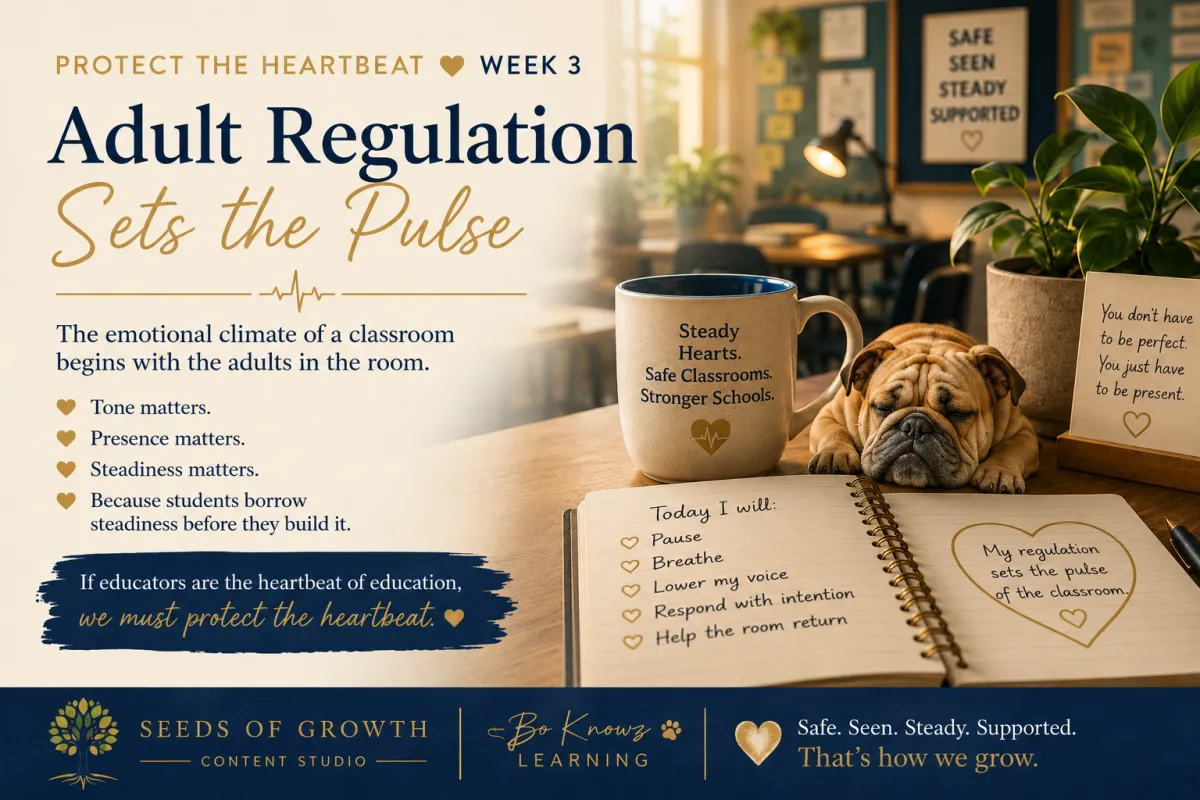
Adult Regulation Sets the Pulse
Protect the Heartbeat, Week 3
There is a moment in every classroom when the emotional temperature begins to shift.
A student refuses.
A transition becomes noisy.
A small conflict starts to grow.
A lesson does not land the way it was planned.
Someone pushes a boundary.
Someone needs more than the adult expected to have available.
In those moments, the classroom is responding not only to children's behavior.
It responds to the adult nervous system.
That does not mean educators are responsible for controlling every feeling, preventing every hard moment, or staying perfectly calm at all times.
Educators are human.
They get tired.
They get frustrated.
They get overwhelmed.
They have days when their capacity is lower than they wish it were.
But adult regulation matters because students do not only listen to what adults say.
They also feel how adults arrive.
They feel tone.
They feel pace.
They feel tension.
They feel safety.
They feel whether the adult is steady enough to help the room find its way back.
This is one of the central truths behind The Heartbeat Educator:
The adults set the pulse.
Regulation Is Felt Before It Is Explained
Before students can use the strategy, follow the direction, repair the relationship, or re-engage in learning, they are often first responding to the emotional climate around them.
Is this room safe?
Is the adult in control of themselves?
Can I make a mistake here?
Will I be shamed, dismissed, or supported?
Is this a place where I can recover?
Those questions may not be spoken out loud, but students are constantly reading the environment.
Adult regulation becomes part of that environment.
A steady adult can help a room settle.
A regulated tone can keep a moment from becoming a power struggle.
A calm pause can give a student enough space to return.
A grounded response can communicate, “This moment is hard, but we are still safe.”
That is powerful teaching.
And it is also deeply demanding work.
Co-Regulation Begins With Us
We often talk about helping students regulate.
We teach breathing strategies.
We create calm corners.
We use feeling charts.
We build routines.
We encourage students to pause, name emotions, and make better choices.
All of that matters.
But co-regulation begins with the adult.
Students borrow steadiness before they build it independently.
They learn what calm feels like by experiencing calm with another person.
They learn repair by being repaired with.
They learn emotional safety through repeated moments where adults respond with clarity and care instead of shame and escalation.
That does not mean educators must be emotionless.
In fact, students do not need robotic adults.
They need real adults who can model what it looks like to feel something, pause, recover, and respond with intention.
That is regulation.
Not perfection.
Not pretending.
Not suppressing everything.
Regulation is the ability to notice what is happening inside us and choose how we want to respond.
Tone Is a Tool
One of the most powerful tools an educator has is tone.
Tone can invite.
Tone can protect.
Tone can redirect.
Tone can repair.
Tone can also escalate, even when the words are technically correct.
A teacher can say the right thing in a way that communicates frustration, impatience, or shame.
A teacher can also hold a firm boundary in a way that communicates safety, dignity, and belief.
That is why tone matters.
Not because educators should sound gentle every moment of every day.
But because tone shapes emotional meaning.
Students often remember how something felt long after they forget the exact words.
A steady tone says:
I am here.
I am not afraid of this moment.
I will hold the boundary without disconnecting from you.
We can get through this.
That is the heartbeat of a healthy classroom.
The Cost of Constant Regulation
Here is the part we cannot ignore:
Adult regulation is not automatic.
It requires capacity.
And capacity is shaped by conditions.
A teacher who is exhausted, unsupported, rushed, criticized, overloaded, or emotionally depleted may still care deeply about students.
But caring does not magically create nervous system capacity.
This is why educator well-being is not separate from student success.
We cannot ask adults to co-regulate all day while working in systems that leave them chronically dysregulated.
We cannot ask teachers to set a steady pulse while ignoring the stress they are carrying.
We cannot ask educators to create emotional safety for students without also creating emotional safety for adults.
Adult regulation is both an individual practice and a culture responsibility.
What This Means for School Leaders
If adult regulation sets the pulse, then school leadership matters deeply.
Leaders shape the emotional conditions adults work within.
They shape whether teachers feel safe enough to ask for help.
They shape whether mistakes are treated as learning opportunities or sources of fear.
They shape whether communication creates clarity or confusion.
They shape whether educators are given recovery after hard moments or expected to immediately move on.
They shape whether the school culture supports steadiness or depends on constant overextension.
A steady school is not created by asking adults to “stay calm” without giving them support.
A steady school is created through systems, relationships, expectations, and leadership practices that help adults remain connected to their own humanity while doing demanding work.
This is not about lowering standards.
It is about strengthening the adults who are carrying the standards.
What Bo Reminds Me 🐾
Bo is very good at reading the room.
He notices tone.
He notices pace.
He notices when someone is tense, distracted, hurried, or sad.
And when the energy around him settles, he settles too.
That always reminds me that regulation is relational.
We affect one another.
Our nervous systems speak before our words do.
In classrooms, hallways, staff meetings, and leadership conversations, people are constantly feeling the emotional pulse of the adults around them.
Bo reminds me that steadiness is not something we announce.
It is something others experience.
A Reflection for This Week
This week, I invite you to pause and reflect:
What helps me return to steadiness when I feel activated?
What tends to dysregulate me during the school day?
Where do I need more support, recovery, or clarity?
How does my tone shape the emotional climate around me?
What would it look like to build adult regulation into the culture of a school, not just ask individual educators to manage it alone?
These questions are not about blame.
They are about awareness.
And awareness gives us choices.
As You Move Forward
Adult regulation sets the pulse.
Not because educators must be perfect.
Not because teachers should never feel hard emotions.
Not because adults are responsible for every response students have.
But because the emotional steadiness of adults shapes the emotional climate of the classroom.
Students need adults who can hold boundaries with dignity.
They need adults who can pause before reacting.
They need adults who can repair after hard moments.
They need adults who can model what it looks like to return to steadiness.
And educators need systems, leaders, and communities that help make that possible.
If educators are the heartbeat of education, then protecting the heartbeat means protecting the capacity of adults to remain steady, connected, and human.
That is not a luxury.
That is culture work.
That is leadership work.
That is heartbeat work.
Join the Conversation
If this message resonates with you, I invite you to join us inside The Steady Schools Community — a free space for educators, leaders, and caregivers who are committed to building cultures where adults and students can feel safe, seen, steady, and supported.
Inside the Community, we reflect, share practical tools, encourage one another, and continue conversations like this one with heart, honesty, and purpose.
Join us here:
https://www.skool.com/bo-knowz-learning-7950/about
Because protecting the heartbeat of education is not work we were meant to do alone.
🌱 Protect the heartbeat.